We commit to enable a Billion Lives to
accesss Light from Solar Technologies
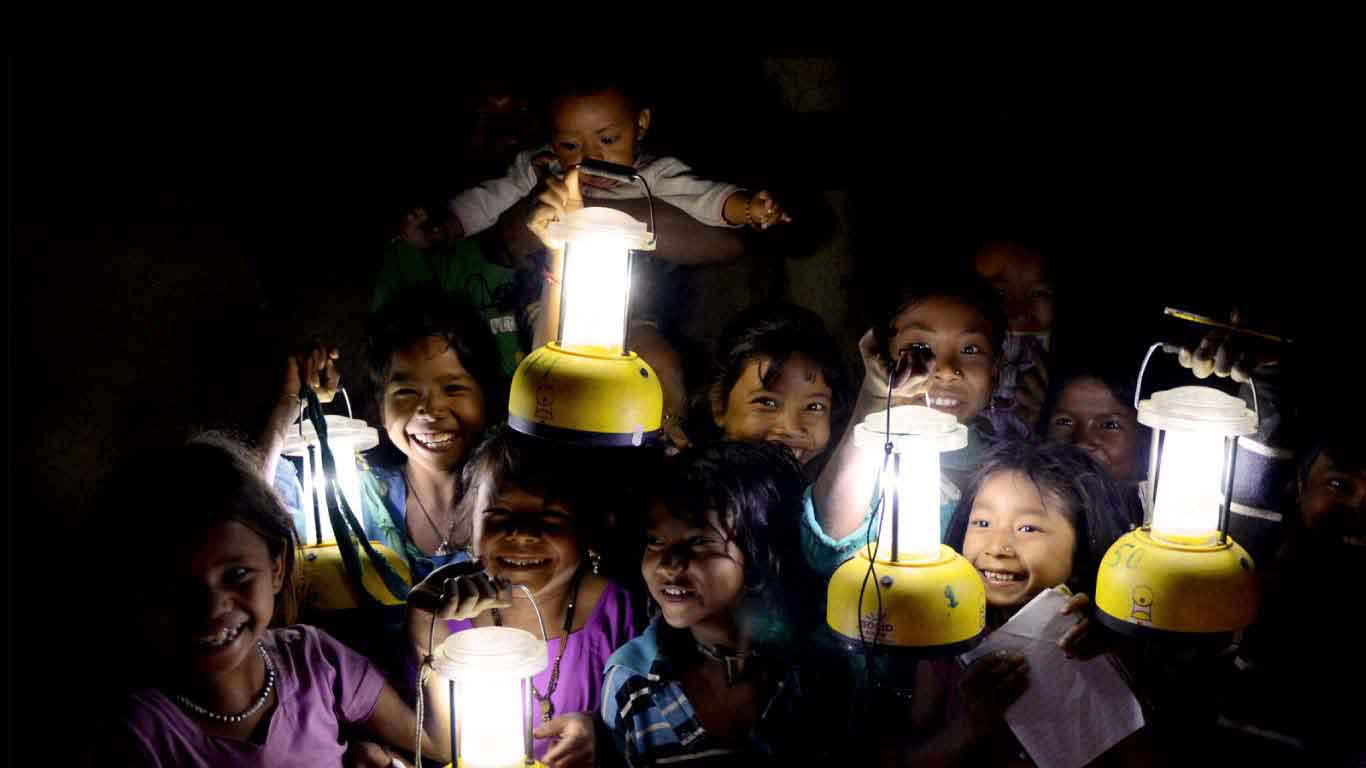
One of the challenges facing the world today is to provide sustainable energy to all its citizens. The task is massive but solutions often come from small, localized initiatives. Lighting a Billion Lives © is one such initiative.

It is a known fact that clean and affordable energy is elementary to one’s quality of life as well as for ensuring socio-economic development. Without access to affordable energy it will be impossible to eradicate extreme poverty and hunger; achieve universal primary education; promote gender equality and empower women or even reduce child mortality and improve maternal health.
The Lighting a Billion Lives campaign is making a concerted effort towards addressing these critical issues as well as bringing about innovations to facilitate interventions enable energy access for all. It has the global understanding of the challenge of providing clean lighting to billions that are at the bottom of the pyramid, and has adopted a localized, bottom-up approach to addressing it.
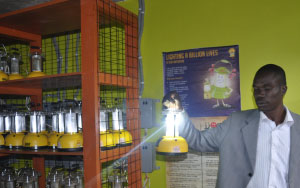
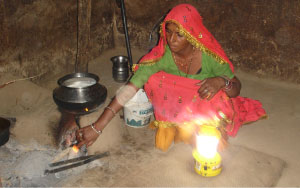
LaBL is based on an entrepreneurial model of energy service delivery which seeks to provide high-quality and cost effective solar lamps, disseminated through micro solar enterprises set-up in un-electrified or poorly electrified villages. These enterprises are operated and managed by a local entrepreneur trained under the initiative, who rents the solar lamps every evening, for an affordable fee to the rural populace.
Fee for service model: To make solar lighting affordable to the poor sections of society with the user paying only a nominal daily rent. Capital costs are supported by grant to a large extent.
Loan finance model: Providing an option to the operators to take up solar enterprises as their own enterprise by facilitating loans (through financial institutions) and subsidizing partial cost of the enterprise (through TERI and/or the partner organizations including government agencies).
LaBL is a unique and measurable sustainability initiative that effectively demonstrates how public- private-people partnership easily supports developmental schemes and initiatives particularly in the area of rural energy access. It started with a pure grant-based model for testing the entrepreneurial fee-for service delivery model which otherwise was not tried on a larger scale in India and gradually moved to a more flexible equity and investment based model for scaling up. It has been able to address two key challenges of (1) scaling up and (2) diversification of funds by demonstrating credibility through ground results and proof of concept. LaBL has been able to achieve this since it aligned itself with government agenda and offers financial viability to attract equity along with technology customization and effective monitoring mechanisms. More >>
The existing gap in implementation and sustenance of rural energy projects is that of a network of local-level institutions that facilitates micro-implementation of project deliverables, carry out training and capacity building and ensure after-sales services. TERI identified this gap and realized the need for creating a new institution called Technological Resource Centres (TRC). LaBL-TRC is a local level enterprise which provides after-sales service support to LaBL SCSs and is also authorized to market and sell LaBL solar products in a specified territory. Apart from providing next door and reliable after-sales support, it also aids in imparting training and local capacity building for the execution of other energy access projects in the area. It is also trained to service other energy access projects in the area to earn its income A network of incubation centres such as a TRC would not only ensure smooth penetration of newer technology but also its adaptation at the grassroots level. Realizing the crucial role that TRCs will play in rural development, DFID is supporting TERI to set up more than 400 such centres across the country.
Lighting a Billion Lives has also received tremendous support from the media. In fact, for 3 years in a row NDTV, one of India’s largest television news networks’ has been airing an annual, dedicated 24-hour show Greenathon, India’s first telethon fund raiser. It has upped the ante in providing the necessary fillip by creating awareness about the challenges of clean lighting amongst the masses and garnered support from across different segments of society. In particular, it has provided a unique platform to engage socially conscious companies to make a positive difference to communities under their CSR activities. In addition, the India Chapter of the International Advertising Association (IAA) launched be India’s largest ever Public Service Communication Programme for Lighting a Billion Lives in the year 2009 to raise awareness and mobilise funds for the initiative


In 2007, at the Clinton Global Initiatives annual meet, TERI committed to bring light and socio-economic development to a million rural people in India. This commitment could only be achieved by displacing kerosene and paraffin lanterns with solar lighting devices within a span of four years. Within a year since that pledge, the idea evolved to encompass a billion people around the world. This unique and far-sighted campaign that illuminates the path to achieving the UN’s Millennium Development Goals- Lighting a Billion Lives - was formally inaugurated by Dr. Manmohan Singh, Prime Minister of India, on 7 February 2008 during the Delhi Sustainable Development Summit.
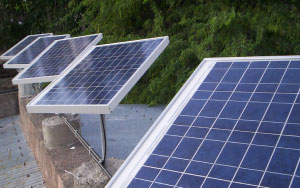
A typical solar charging station consists of 50 solar lanterns, 5 solar panels, and 5 junction boxes. The solar lantern generates light for 4-6 hours daily, providing illumination of 200-250 lumens or the light equivalent to a 40 W incandescent bulb. The LED lamps work for a full night (about eight hours) if operated on the dimming mode. The centralised solar charging stations are set-up in villages and lanterns are provided on rental basis to households and enterprises in the evening.

| Features | |
|---|---|
| Solar Panel(50W): | 5 |
| Junction Box (with 10 ports): | 5 |
| Solar Lanterns | 50 |
Photovoltaic power panels are installed in modular units allowing generation capacity to scale up easily to meet demand. Power is generated during the day but consumed at night. To bridge this gap, one or two battery banks charge during the day while power is generated and discharged at night when consumers are lighting their houses. Power is distributed over a short distance from the battery banks to the cluster of households or shops (each cluster comprises of 20 to 100 households or shops) within the village. Low voltage electricity is distributed for 4 hours each night to power the household/shop lights. By utilizing LED lights, power consumption per connection is reduced, thus reducing the requirements to distribute large quantities of power. Each household / shop is provided with one or two LED lights which provide superior quality lighting than kerosene lamps at comparable cost. Use of solar energy eliminates any fuel supply needs.

| Features | |
|---|---|
| Households covered | 50 |
| Solar panel (24V, 400Wp) | 4 |
| Battery (24V, 100Ah, VRLA battery) | 4 |
| Charge controller Unit (CCU) (24V, 20Amp) | 1 |
| LED lamps/light (2W, 1W) | 100 |

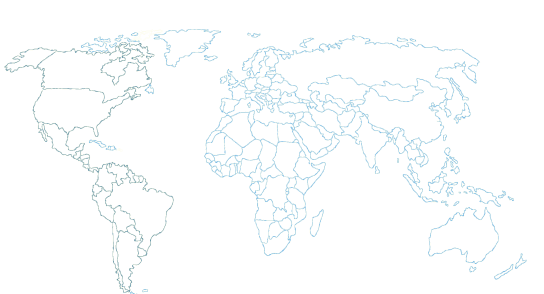
The campaign is also spreading its light across Africa, South Asia and South East Asia. Besides providing solar lighting to villages in African countries to further UNMDGs the LaBL campaign is also expanding through local partnerships, beginning with 2 solar charging stations in Sierra Leone Also, under the Asian Development Bank’s Lighting for All initiative, Lighting a Billion Lives is poised to bring modern lighting to 50 million people in Asia-Pacific by 2015.